Bidirectional knife gate valve
A standard knife gate valve seals best when line pressure pushes the gate onto its seat. In lines where flow reverses, where the valve sits at a dead end, or where pressure may come from the downstream side during cleaning, a bidirectional knife gate valve is needed. Its seat arrangement seals against pressure from either direction, so you can install it without worrying about the flow arrow.
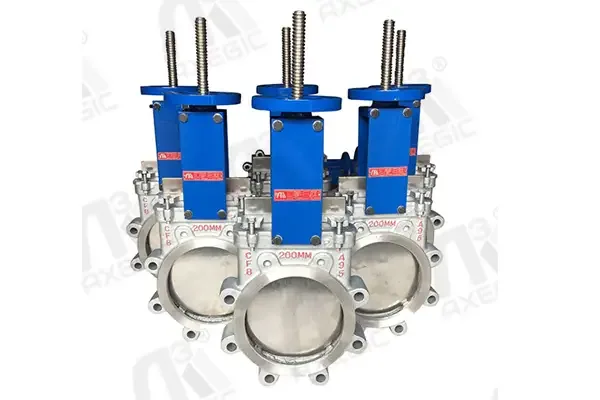
Axegic bidirectional knife gate valves are available with a metal seat and renewable soft seal, elastomer seat or PTFE seat, in rising and non-rising stem configurations with wafer or full-lug bodies.
Benefits
- Tight shut-off in both flow directions, minimising leakage.
- Straightforward maintenance that reduces downtime and operating cost.
- Can be customised to specific operating requirements.
- Materials from cast iron and ductile iron to carbon steel, stainless steel, duplex, super duplex, Alloy 20 and Hastelloy.
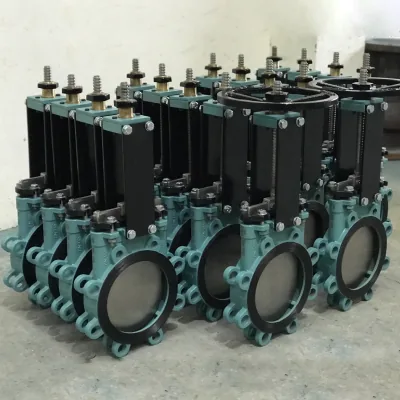
Fabricated knife gate valve
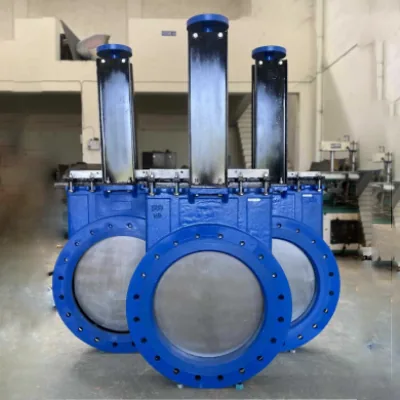
When the required size is beyond standard castings, or the face-to-face and port shape are non-standard, Axegic builds the body by fabrication from carbon steel plate. Fabricated knife gate valves are widely used for highly viscous powder and slurry service, in uni-directional or bi-directional versions, for isolation and on-off duty.
Fabrication also suits square and rectangular ports – see the square type knife edge gate valve – and short-lead-time replacements where a pattern does not exist.
Specification
| Size range | Up to 36″ (900 mm); larger sizes on request |
|---|---|
| Pressure rating | ASME Class 150, PN10, PN16 (other classes on request) |
| Design, manufacture & face-to-face | MSS SP-81 |
| End connection | Wafer, lugged or flanged – ASME B16.5 / B16.10, PN10 / PN16, Table D & Table E |
| Testing | API 598 / BS 6755 Part I |
| Seat options |
|
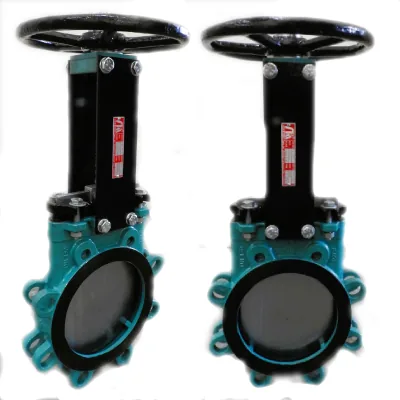
| Operation | Handwheel, chain wheel, gear, pneumatic cylinder, electric actuator, hydraulic cylinder |
| Body materials |
|
Operation & automation
Choose handwheel, chain wheel or gear operation, or automate the valve with a pneumatic cylinder, electric actuator or hydraulic cylinder. The pneumatic version shown above is popular for ash handling and slurry lines controlled from a DCS.